Your Website Has a Federal Accessibility Deadline. Here’s What That Actually Means.
For the first time, the federal government has set a specific technical standard for public institution websites. If your organization is a public school, university, or government agency, the clock is running.
By Media Genesis
If you manage a website for a public school, a college, or a government agency, accessibility has probably been somewhere on your list for a while. Maybe it came up in a meeting. Maybe someone flagged it as something to look into. Maybe it got pushed to next quarter. Again.
That calculus changed in April 2024. The U.S. Department of Justice finalized a rule under Title II of the Americans with Disabilities Act that does something it has never done before: it names a specific technical standard that public institutions must meet. Not a general principle. A specific standard, with a specific deadline.
What the Rule Actually Says
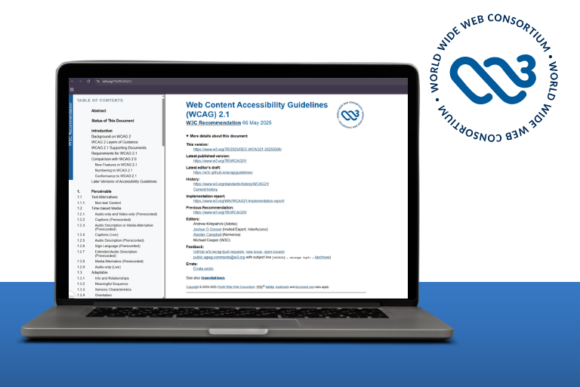
The standard is called WCAG 2.1 Level AA. WCAG stands for Web Content Accessibility Guidelines, a framework published by the World Wide Web Consortium. Level AA is the middle tier. Think of it as the functional standard: your site needs to actually work for people with disabilities.
In practical terms, WCAG 2.1 Level AA covers things like sufficient color contrast so that people with low vision can read your content, keyboard navigation so that every interactive element works without a mouse, text alternatives for images, and compatibility with screen readers (the software blind users rely on to navigate the web).
It also extends beyond your web pages. Digital documents posted to your site, such as PDFs of meeting minutes, annual reports, or application forms, fall within scope. If someone can download it from your site, it needs to be accessible too.
None of this is technically exotic. These are solvable problems. They do require intentional attention, and most websites have not had that.
Who This Applies To
Title II covers state and local government entities. That includes public school districts, public universities, community colleges, public libraries, and municipal agencies.
Private institutions are not covered by Title II. They carry separate obligations under other parts of the ADA and face active litigation risk, with courts using the same WCAG 2.1 AA standard as the benchmark. Organizations that receive federal financial assistance of any kind should also look into Section 504 of the Rehabilitation Act of 1973, which creates parallel accessibility obligations tied to that funding.
When You Need to Be Compliant
The original compliance deadlines were extended in April 2026. The current dates are:
April 26, 2027: public entities serving populations of 50,000 or more
April 26, 2028: public entities serving populations under 50,000, and special district governments
A year or two can feel like enough runway. It is not. Getting a website to a fully documented, audit-ready state requires assessment, remediation, testing, and an ongoing monitoring program. Organizations that wait until twelve months out are going to feel it.
What Non-Compliance Looks Like
The DOJ can investigate complaints filed by individuals and require corrective action. Beyond federal enforcement, the rule creates exposure to civil litigation. What matters in those cases is not whether your site is perfect. It is whether your organization had an active, documented compliance effort in place.
An organization that can show sustained, good-faith work toward accessibility is in a fundamentally different position than one that cannot. That documentation piece matters more than most organizations realize. It is not just about fixing your website. It is about being able to show the work.
Where to Start
The first step is understanding where your site currently stands. An accessibility audit maps what your site gets right, what needs attention, and what falls into a gray area. From there, remediation is a process, not a single event. Accessibility is maintained, not achieved once and forgotten.
At a minimum, any organization operating under a Title II deadline should have automated monitoring running on their site, human expert review for the issues automation alone cannot catch, a process for handling user-reported accessibility issues, and documentation of the ongoing effort.
It is also worth reviewing digital documents on a regular cadence. Anything posted to your site as a downloadable file falls within scope of the rule.
Media Genesis has been working with organizations on web accessibility for years. If you are trying to figure out where your site stands or what a compliance program should look like, we are happy to have that conversation. Reach out to our team at mediag.com.
Our Related Work
AgeWays Website Redesign: Enhancing Accessibility and Engagement for Seniors and Caregivers


.png)