Your Google Rankings Still Matter. But They Are No Longer Enough.
A practical guide to staying visible when AI answers the question before anyone clicks.
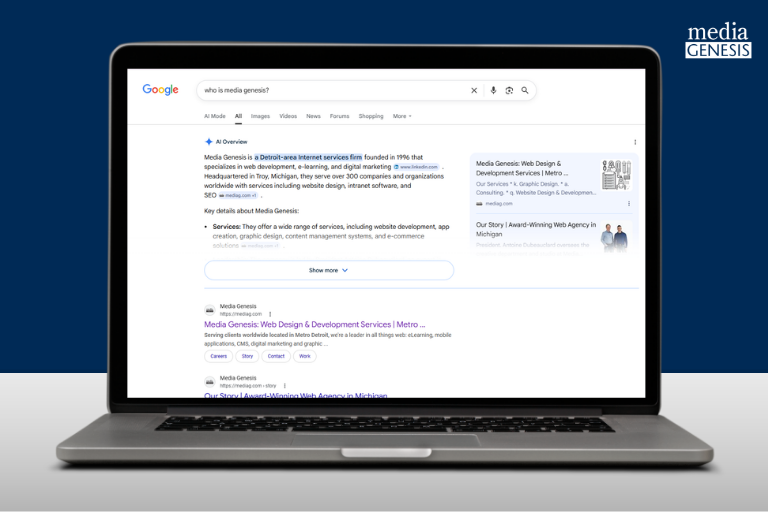
Imagine this. You search Google for “best CRM for a small law firm.” A year ago, you would have seen ten blue links and started clicking. Today, you see a paragraph at the top of the page. Google has already read the internet for you, pulled together an answer, and presented it in a tidy summary. Maybe it mentions a few brands. Maybe it links to a couple of sources. But for a lot of people, the search ends right there.
That paragraph is called an AI Overview. And it is quietly reshaping how businesses get found online.
If you have spent years building your website, investing in SEO, and climbing Google’s rankings, this matters. Because the rules of visibility are shifting under everyone’s feet. The good news? The businesses that understand what is happening have a real opportunity to pull ahead. The ones that ignore it will wonder why their traffic keeps dropping even though their rankings look fine.
What Is Actually Happening to Google Search
Google now uses AI to generate summaries at the top of search results for a growing number of queries. These are AI Overviews. Think of them as Google reading dozens of web pages on your behalf and handing you the short version.
Google frames this as part of an “information journey” that helps users dig deeper. But the practical effect is significant: when people get a summary before they ever see your website, fewer of them click through. The data on this is striking.
Ahrefs analyzed 300,000 keywords and found that AI Overviews correlate with a 58% lower click-through rate for the top-ranking page. That means for every 100 people who would have clicked your link before, only 42 do now. Seer Interactive found similar numbers across 42 organizations: organic click-through rates on queries with AI Overviews dropped from 1.76% to 0.61%. That is a 61% decline.
Pew Research Center looked at actual browsing behavior and found that when an AI summary appeared, users clicked a traditional result only 8% of the time, compared to 15% without one. Clicking a link inside the AI summary itself? About 1% of visits.
Here is the critical detail: being mentioned in an AI Overview changes the outcome. Brands cited inside the summary received 35% more organic clicks and 91% more paid clicks than when they were left out. Visibility and traffic have started to separate. Where you rank still matters. But whether AI includes you in its answer matters more.
This Does Not Affect Every Search the Same Way
AI Overviews do not show up uniformly. They appear on about 21% of keywords overall, with much higher rates for question-based and longer searches. But they are expanding beyond informational queries into commercial, transactional, and even branded searches.
Understanding how different types of searches are affected helps you focus your energy where it counts.
Local searches (“best pizza near me”)
These are the least affected right now. Only about 7.9% of local searches trigger an AI Overview, well below the average. Google’s local results still rely heavily on location, reviews, and accurate business information. If you are a local business, your Google Business Profile, review count, and consistent contact information remain your strongest assets. That has not changed.
Educational searches (“how to file a tax extension”)
These are where AI summaries hit hardest. When someone asks a detailed how-to question, Google’s AI can synthesize an answer from multiple sources and present it directly. For businesses that rely on educational content to attract visitors (think: financial advisors, healthcare providers, legal firms), the traffic impact is real. The key to surviving here is producing content that goes beyond the surface. AI tends to cite sources that are specific, well-structured, and clearly authoritative. Generic how-to guides that repeat what is already everywhere become invisible.
Product and buying searches (“wireless speaker for TV”)
This is the newest frontier. AI Overviews are increasingly showing up on commercial queries, and Google Ads can now appear above, below, or within AI Overviews. For e-commerce brands and product companies, the winning formula is shifting: authority plus clean product data plus a compelling reason to choose you. Complete, accurate product information (price, availability, shipping, returns) through proper markup makes your pages eligible for Google’s shopping surfaces. Without it, you are leaving opportunities on the table.
What Your Business Should Actually Do About This
The shift is real, but the response is practical. SEO is not dead. What has changed is the definition of winning. Your website now needs to serve three audiences at once: traditional search rankings, AI summarization systems, and conversion surfaces like local packs and shopping panels.
A research paper from Princeton University introduced a concept called Generative Engine Optimization (GEO). The researchers found that specific content tactics (adding citations, statistics, and structured evidence) increased visibility in AI-generated responses by up to 40%. Generic keyword stuffing did not help. What worked was content that looked like what strong SEO has always looked like, but with more rigor and intentionality.
Here is what that looks like in practice.
- Make your content easy for both humans and machines to understand. Use clear headings, logical structure, and descriptive titles. Link between related pages on your site. Google’s own guidance calls out internal linking and text accessibility as best practices for AI features. If your website feels like a maze, both visitors and AI will struggle with it.
- Back up your claims. Add real data, cite original sources, and reference specific evidence. The Princeton GEO study found that content with citations and statistics performed significantly better in AI responses. Think of every page as something you are submitting to a well-informed editor, not writing for a search engine.
- Go deeper than your competitors. Google’s content guidelines explicitly reward original information, research, and analysis that goes beyond rewriting what already exists. AI Overviews trigger at very high rates for question-based queries. The defensive move is to answer the next-level version of those questions. Cover the edge cases, the real-world constraints, the nuances that generic content skips.
- Keep your business information clean and complete. For local businesses: verified Google Business Profile, accurate hours, address, phone number, photos, and active review management. Google ties local visibility directly to these signals. For e-commerce: product markup that reliably communicates price, availability, shipping, and returns. These details determine whether you show up in Google’s shopping surfaces.
- Build trust signals that AI can verify. Google’s quality guidelines place Trust at the center of their evaluation framework (they call it E-E-A-T: Experience, Expertise, Authoritativeness, and Trust). For your website, this means clear sourcing, transparent author information, About pages that establish credibility, and consistent, verified information across the web. Small businesses can compete here by being specific, transparent, and honest about what they offer.
Can Smaller Businesses Actually Compete?
Yes. And in some ways, the shift favors them.
Google has stated that AI features can surface a wider and more diverse set of helpful links than traditional search. That creates a real opening for smaller publishers and brands that own a narrow topic deeply. Niche depth beats generic breadth. If you are the most thorough, most credible source on a specific question, AI is more likely to cite you than a large brand that covers the topic superficially.
Local businesses and e-commerce operators have the clearest advantage. They produce trust signals that big brands cannot easily replicate: real customer reviews, verified business information, responsive engagement, and authentic photography that shows the actual product or experience. These are signals that both people and AI systems value, and they are hard to fake at scale.
Google’s own quality guidelines note that a small website with little reputation is not automatically low quality. What matters is demonstrating expertise and transparency, especially for topics where the stakes are high (health, finance, legal).
A Word About Trust and Reputation in the AI Era
There is a less obvious side to this shift that deserves attention. AI summaries can amplify both accurate and inaccurate information. There have already been documented cases where AI Overviews surfaced incorrect suggestions in sensitive contexts, and situations where fraudulent contact information appeared to be legitimized by AI summaries.
For your business, this means one thing: make sure the web contains consistent, verified information about who you are. Official phone numbers, addresses, policies, and authoritative pages. If AI pulls in bad data because your digital presence is inconsistent, the consequences land on you.
What This Means for How We Work at Media Genesis
We have been watching this shift closely (we wrote about it back in January). The way we see it, the agency’s job has evolved. SEO, content, paid media, local presence, and technical accuracy used to operate in separate lanes. They don’t anymore. They all feed into the same question: when AI looks at the internet, does it understand who you are and why you matter?
That means we focus on three things:
- Presence in AI summaries. Is your brand being cited? Can AI verify your claims? Is your content structured so it can be understood and referenced?
- Eligibility for high-converting surfaces. Local packs, shopping panels, product results. These are the places where clicks still happen and conversions still flow, even as top-of-funnel traffic compresses.
- Measurement that reflects reality. Google reports AI feature traffic inside standard Search Console reporting, not as a separate channel. That means you need to look deeper than overall traffic numbers. Which queries are losing clicks? Where is your brand being cited? How are conversion paths shifting?
The Bottom Line
Google is still the front door for most businesses online. That has not changed. What has changed is what happens after someone walks through it. Increasingly, the answer they are looking for meets them right inside the doorway, before they ever make it to your website.
The businesses that adapt will be the ones that show up inside that answer. They will be the brands that AI trusts enough to cite. That requires clarity, structure, credibility, and consistency. It requires treating your website as a data source for the systems that now guide real human decisions.
The fundamentals of good digital strategy have not disappeared. They have become more important. The difference is that now, doing them well means you are visible in places that did not exist two years ago.
If you want to understand where your business stands in this new landscape, let’s talk. We will show you what AI sees when it looks at your brand, and what it would take to make sure it sees the right things.
Ready to get ahead of this? Reach out to Media Genesis.
Our Related Work
Strategic Digital Growth and Marketing for Money Pickle
.png)