What is SEO in Digital Marketing? Why Metadata Matters
Crafting First Impressions: The Role of Website Metadata in SEO
Start with what people see first.
Before visitors even click on your website, their decision often hinges on a small block of text, your Google listing. Take a moment to search for your company using your primary service and location. Look closely at what’s displayed:
- Does the headline cut off awkwardly or just say “Home”?
- Is the description unrelated, pulling text from cookie settings or an irrelevant page?
For many businesses, this snippet is the first impression potential customers receive; and often, it hasn’t been updated in years.
This is where search engine optimization (SEO) becomes tangible. SEO isn’t just the technical work behind the scenes; it’s also ensuring your website looks professional, trustworthy, and clickable in search results. A well-optimized Google listing can make your site stand out, drive clicks, and capture leads that others miss.
What is SEO and How Does It Work in Digital Marketing?
SEO, or Search Engine Optimization, involves improving your website’s visibility so search engines like Google and Bing can easily find, understand, and recommend it. It also ensures your listing is appealing enough to encourage users to click on it.
SEO is part of the larger digital marketing ecosystem, alongside paid ads, email marketing, and social media. Its unique advantage lies in its organic traffic, so you don’t pay for every visitor. Unlike paid ads that stop when the budget runs dry, a well-optimized page can generate traffic for months or even years.
Key Areas of SEO:
- Technical SEO: Ensures search engines can access and index your pages.
- Content SEO: Focuses on answering real user queries with relevant content.
- On-Page SEO: Includes metadata, content structure, headings, and internal linking. This makes your pages visually appealing and strategically written to encourage clicks.
Why Search Rankings and SERP Position Matter
When someone performs a search, Google generates a Search Engine Results Page (SERP), ranking results based on relevance, trustworthiness, and usability.
Position is critical. Users rarely dive past the first few results. A Backlinko study of 4 million Google searches found the following;
- The top result earned around 27.6% of clicks.
- The top three results together captured 54.4%.
- On page two, just 0.63% of users clicked on anything at all.
Additionally, with newer AI-generated summaries often appearing at the top, traditional listings may be pushed further down. This makes optimizing your listing, for ranking and readability, more important than ever.
Anatomy of a Search Result
Your meta title and description are what people read before they decide to click. However, Google frequently generates its own title links and snippets. Metadata influences results but doesn’t guarantee what users see.
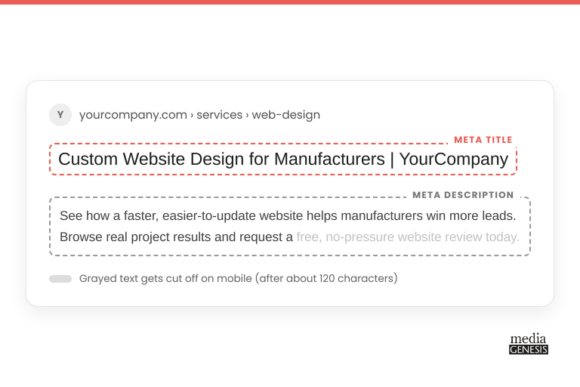
Understanding SERP Elements: The Power of Metadata
Every organic search result consists of three key parts:
- Title Link: The clickable headline, also known as the meta title.
- Snippet: The short, two-line description (meta description).
- Site Name and Web Address: Your domain and brand name.
Your meta title and meta description play a vital role in shaping your SERP visibility:
- Meta Title: A piece of code that labels the page. It serves as the headline seen in results and browser tabs.
- Meta Description: A brief summary stored in code that tells users (and search engines) what the page is about.
While search engines often pull snippet text from page content, providing well-optimized metadata increases the accuracy of what gets displayed. Neglecting it can result in generic or irrelevant text being shown instead; harming your credibility. One thing to flag: Google does not use meta descriptions to decide where your page ranks. Their real value is helping searchers understand your page before they click. A well-written description can raise your click-through rate (CTR), the share of people who see your listing and choose to visit.
Guidelines for Meta Title and Description Optimization
To ensure your metadata maximizes visibility and clicks, follow these best practices:
Best Practices:
- Write Unique Titles & Descriptions: Avoid duplicates across pages, Google may rewrite or disregard repetitive metadata. Your meta title and description are what people read before they decide to clicis makes pages harder to distinguish in search results.
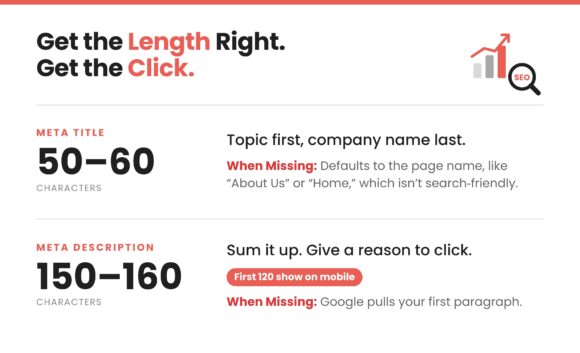
- Prioritize Important Words: Start with the key topic and save your company name for the end of the title.
- Write for Your Audience: Avoid keyword stuffing; instead, craft descriptions that appeal directly to readers.
- Deliver on Promises: Ensure the title and description match the actual page content.
Make sure the Meta Title is between 50-60 characters, and that the Meta Description is between 150-160 characters.
Why Metadata Often Goes Overlooked
Websites evolve over time: new pages are added, blogs are published, and campaigns are launched. In the process, placeholder titles, copied descriptions, or outdated metadata often remain unnoticed, creating gaps that hinder SEO performance.
Common issues include:
- Blank or duplicate metadata across pages.
- Titles and descriptions written years ago and never updated.
- Missing redirects or broken links.
- Content no longer matches its metadata, or the keywords visitors are searching for.
These overlooked details impact user experience, search visibility, and ultimately the flow of traffic to your site.
Take the First Step
Think back to the search you performed at the start of this post. If your listing included:
- A clear headline
- An engaging description
- A position near the top of the page
… then you’re off to a solid start. If not, your first SEO project is right in front of you.
Much of SEO comes down to small, manageable steps anyone can understand: a well-written page title, a compelling description, and a site that’s easy for search engines to read. These details shape whether someone clicks on your link, or chooses a competitor instead.
The Value of a Website SEO Audit
A site audit provides a full analysis of your website, revealing what works, what’s missing, and what needs improvement. Tools crawl every page of your site, flagging errors like broken links, duplicate content, missing metadata, and more. Once you’ve updated your listing, set up Google Search Console to track the results. This free tool shows your impressions, clicks, CTR, and average position, so you can see whether your changes are bringing in more visitors over time.
At Media Genesis, we take this a step further—evaluating technical performance, usability, and content relevance. Our audits answer questions like:
-
- Do all pages have unique, optimized metadata?
- How do your top pages actually appear in Google search results?
- Are there structural or technical issues (like page load speed or mobile responsiveness) blocking your site’s growth?
Contact us today to schedule a site audit and start building stronger brand visibility through SEO.
Our Related Work
Turning Big Traffic into Qualified Leads for Munro & Associates

.png)